Saturday, 9 March 2013

Links à la Mode

linksalamode0307

This week I was fortunate enough to be featured on Independent Fashion Bloggers 'Weekly Roundup' page. The web links below are a wonderful mix of fashion and lifestyle posts from the IFB blogging community, including the "heartwarming story" of my mother's vintage dress ('Like Mother, Like Daughter). Do take a read!


Links à la Mode: The IFB Weekly Roundup For March 7th:

  SPONSOR: Shopbop New: Lisa Perry, Love Sam, Ketzali, Rachael Ruddick , Ivy Kirzhner, Chrissie Morris, LRK, Frye Bags, Love Leather, Lisa Perry, Wes Gordon

Sunday, 3 March 2013

Like Mother, Like Daughter


Dress: Vintage Calico Casa Shoes: Topshop 


There are said to be certain clues in a woman’s life that confirm that you are turning into your mother. A turn of phrase or familiar facial expression will somehow make their way into our mannerisms and we realise that the transformation is inevitable. Nowadays though, people have started to celebrate the symmetry shared with parents in ways both abstract and physical.  Parents are regularly cited now as sources of style inspiration. In the case of the dress in these photographs however, the focus shifts from the traits passed down through genes and DNA to a story inherited second-hand; petticoated in until very recently. A dress born from an act of creativity which circuits mother and daughter decades after its genesis.

It was upon a warm June evening last year whilst perusing vintage clothes on Ebay that a winding chain of hyperlinks led me to a “Vintage Evening Dress Designed by Jillienne at Calico Casa”. The small black script in the stream of pixelated grayscale was enough to catch my attention. I knew instantly that the dress was one of my mother’s designs. The crocheted bodice, the blue and teal palette, the flowing skirts. Sewing styles are distinctive snippets of character, like handwriting or voices; meaningful to those with the knowledge to decode and identify a connection. I could have recognised it anywhere.

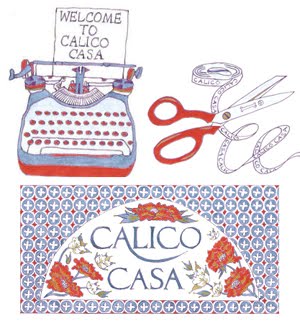
It was back in the summer of 1971 that a sunny haired, sparkly eyed twenty one year old girl first acquired the keys to a high street shop in Northampton. With hard work, a lick of paint and plenty of creative enterprise, Calico Casa was born. A fashion boutique, a hippy emporium, a bespoke dressmaking establishment - people remember it differently according to its phases of development. Gilly, as my mum was known to her customers, had been part of the first wave of people beginning to holiday abroad in sunnier climes. Having lived on the Ibiza sands for a year she returned to the Midlands with a seed of an idea and youthful energy to buoy her plans. Apart from Chelsea Girl or Biba, it was a tough task for young women to find accessible fashion outlets and assert their individuality. The high street giants of mass produced clothing didn’t exist and internet shopping hadn’t even been dreamt of. Seventies bohemia was far from modern day ubiquity; it was alive and kicking.

With this in mind, my mother decided to open her own retail outlet creating beautiful, affordable creations. In just a couple of years, Calico Casa was thriving, boosted by the word of mouth and praiseworthy recommendations. Often three generations of women would come in to visit Mum to place their orders together, side by side. Gilly was rarely seen without her trademark navy calico skirt lapping at her ankles; nicknames ‘Mrs Blue’ by her team of machinists. Together they designed ruffled gypsy skirts and boleros for fun loving city girls. Strictly no turtle necks or bell bottoms; Calico Casa creations were light, bright and romantic; they were carefree.

Maybe it was the years of history hanging on its hem or personal affiliation seamed in the frothy skirts but when the ebay parcel finally arrived and I wriggled into the dress for the first time, I realised the true transformational quality of clothes. It is forty years old now or thereabouts, and still as perfect as the time when Scott Mackenzie sang about wearing flowers in your hair.  

The knowledge that someone wore and loved this Calico Casa dress makes me smile as much as the joy of owning a tangible piece of family history does. I imagine that once, a young woman, perhaps the same age as I am now, swished along the city streets as she shopped or danced under an indigo sky at a party. The Calico Casa aesthetic was built on femininity and independence, not unlike the style and character I aspire to nowadays. As I wear this dress the memories are layering over old ones. I like to think that writing about my discovery adds to the palimpsest; a continuation of words and fabric that overlap with my mother’s and multiply as the dress begins another lease of life. 

Saturday, 26 January 2013

Journeying On


Santa Barbara beach


The start of a new year is more often than not bound with thoughts of clean slates, fresh starts and lists of resolutions. Whilst the opportunity to begin anew and make positive changes in our lives seems almost ritually inherent in New Year’s festivities, viewing the new year as an exclusive time to enact change is in need of its own makeover. For me, a new year is not about papering over old memories, but adding more colour and texture to one's life story. These experiences, discoveries, interactions and achievements are the means by which we formulate identity. In the same way, I view life as a process of continuation and enrichment; not a roll of film in which the impressions made can be mechanically chopped, edited and manipulated in order to produce a desired effect.

As another chapter of my life begins in a sunnier climate, I would like to send you my warmest greetings from America! I am currently studying abroad in California; a period which I feel sure will afford me a wealth of new experiences, knowledge and friendships; the process of which has already been set in motion even in the two weeks I have been here.

Not at any point during my application to study abroad as I trawled through paperwork, endured the laborious visa process, paid for my flights, packed my bags and said my goodbyes had I actually considered what I was really doing. Not even as I stumbled through LAX airport, dog-tired, jet-lagged and suitcase laden did I stop and think where I was. It wasn't until I had arrived at my university halls and been shown to my room that I actually stopped, looked at my surroundings and wondered for the first time what I was doing in California.

Sometimes I cannot explain the choices I make. Least of all when someone asks me the question point blank; “Why are you studying abroad?”  Sometimes we are the least suitable candidates to delve into the thoroughfares of our own psyche in order to find these answers.

For now, I am happy to say that I am on the pursuit of happiness. When I am asked questions about my travels, I am not content to wring out justifications and conventionalities pre-formed in my mind. I don't always want have to have an answer for everything; rather I want to let the answers emerge naturally through experience.

Blog posts will from now on be a pastiche of fashion, memoir, opinion and study abroad observations. Do keep reading!


Sunday, 4 November 2012

Forget Your Troubles


We’ve all had those kind of weeks. When someone enquires after your health and for the sake of hassle, you plump for “great thank you” rather than beat down the poor unassuming person with a list of peeves and problems. For some reason or other, I’ve had backache all week. Of course, Mum had something to say on the matter.
“It’s your own fault, you never do as I say and take two Ibuprofen before the pain kicks in”.
My Mum is the only person I know, or have indeed heard of that believes in preventative medication. She will take two Ibuprofen regularly in the course of her day, i.e before driving or going for a walk so that she’s one step ahead of any pain that might conspire to bring her down. This made me howl with laughter when she first told me of her scheme. Needless to say, Mum is having the last laugh.
Luckily, I did anticipate that somewhere down the line in the grip of winter I would quite possibly (unquestionably) require a pick-me-up when I felt like hibernating forever. Over the summer I started to stockpile lots of photos; not unlike the manner of a squirrel storing away pine-nuts for an unadulterated feast when things got bleak.
The afternoon I took these photos I was having a casual stroll through the delightful Old Spitalfields antique market (not to be confused with the Traders Market or Arts Market). Spitalfields is the oldest market in London, nestled in the heart of the city by Liverpool Street. It dates back to 1638 when Charles I issued a licence for the sale of livestock. The market evolved ever since and underwent significant structural renovation in the Victorian period. The old part of Spitalfields remains largely unchanged and it is there, as you walk through the red brick archway that it is possible to feel a whisper of the past. It is extremely atmospheric; and it is these types of places whose histories and stories can all too easily evaporate in the face of modernity.
Old Spitalfields antique market teams with people as soon as the doors open. Dealers, traders, antique enthusiasts, collectors, whether professional or casual soon merge into a simmering brew of punters, all beadily searching for a find. It is impossible to comprehensively describe the wares for sale. The market truly is a treasure trove. Tables and trestles teeter with piles and boxes of stock, jewellery hangs in bunches off meat hooks and fur coats are stuffed in wardrobes.
As I was meandering along, I heard some wonderful Argentinian music drifting down the mall. Upon following the tune I discovered that outside underneath the Amphitheatre Canopy, complete with DJ, were a whole crowd of tango dancers spinning in the summer sunshine.
There was seating all the way around the circular dancing area for the public to watch. And watch they did; it was clear to see people were captivated. The crowds grew larger but fell quieter under the spell of the dancers and melodies alike.
For the next two and a half hours I sat drinking tea and taking photos of the dancers. What amazed me the most was how proficiently they moved around the small space, skilfully rotating round each other like satellites, never once colliding. And as each song ended, and partners swapped, the new dancers would move in synchronicity once more like they’d known each other for years. It was beautiful to watch such a diverse group of dancers interact and perform. This is part of the beauty of Argentinian tango; allowing people from all walks of life to come together in the tango embrace to share a connection and create a moment.
Unbeknownst to me, this event is an initiative between Tango-Fever, a community dance group run by René Hellemons and Hiba Faisal, and Spitalfields, which runs annually from May to September. It allows Londoners to participate in a unique opportunity to tango outdoors in a public area. You can read more about this wonderful collaboration here.
I hope that these dancers have brought a little sunshine to your day as they have done for me. As a little something extra, I have photographed just some of the gems that I have ‘magpied’ along those very aisles. Everything is vintage or antique-this is the only jewellery that I wear. The craftsmanship and beauty is generally unparalleled nowadays, and allows you a sliver of that history belonging to a bygone age.


Friday, 12 October 2012

Material Girl


The Calico Toile

Sometimes it is not until something beautiful or revolutionary is delivered unto our consciousness, born from the commonplace, that we will appreciate what can be forged from a raw substance or material. Our instincts may remain muted, our intuition nestled in shadow whilst our daily lives are crosshatched with routine. Though our ability to detect potential and produce ideas may often lay dormant, there is little doubt that with the right stimulus, knowledge and skill, even the smallest idea may be brought to fruition. Freeing these ideas from our brains and watching others do so is like observing butterflies flutter from the cocoon, riding the breeze for the first time. Creativity is a form of liberation.

It might seem a little incongruous then, that I should then turn to the material calico as my particular source of freedom. Shouldn't I be contemplating jeans or the push-up bra to highlight the brilliancy of modern inventions and their emancipatory effects? Not necessarily so. Calico is a material used for constructing a toile; a prototype of a handmade garment in the art of dressmaking. It is raw, unyielding and holds an inherent beauty in its plain weft and weave. Most importantly it is impressionable; perfect for moulding, dying and scribbling on. It is an integral part of a creative design process and stimulates my obsession with bringing just a little more beauty into the world.

On a personal level, calico bears holds many different threads of significance. It is the means by which my mother was able to start her fashion emporium; her boutique Calico Casa, when she was twenty years old. Calico enabled her to hone her bespoke tailoring abilities; it was the means by which to produce 'first-drafts' of numerous silken creations. It was and still remains a trusted companion; for if a prototype fits in calico, you can be sure it will fit in pretty much any fabric you can possible imagine. It is partly the reason that I am able to sew; and furthermore give life and body to ideas that would otherwise be destined to lie silently in the damp recesses of my mind.


When I was but a little chocolate haired child watching my mother sew, I understandably could never grasp the importance of this hallowed fabric. But it is with the addition of wisdom, passion and skill that something so seemingly inconsequential such as calico can suddenly reveal the most amazing metamorphic capacities. By absorbing my mother's instruction and knowledge, I was able to produce tailored garments. I began to view the human form through a new analytical lens. I learnt how to flatter different forms, conceal bodily quirks; in essence, how to tailor to an individual frame. In a miraculous Copernican shift I saw when I worked alongside my mother that we were not simply producing garments for a body; rather, the body was inspiring and governing what we made. The seamless undulations of a slender waist, the majesty of the shoulder blades, even the delicate ridges of the ankle could fuse together in synergy with our creativity and of course, calico threads.

Though they might be unaware, I have watched calico impact upon many people's lives in my lifetime. This modest, creamy material permits designs once conceived in the imagination to become airborne. But these designs have to start somewhere. It is so easy to be swept along on the conveyor belt of fast fashion where all one ever witnesses are finished products hanging uniformly on silver rails. We may never know a shred of information about how that piece came into being. Fashion gives people the opportunity to live their lives in a majestic art form, which is wonderful. Though I like to view life from the seamy side, so to speak, and often ruminate on how a particular garment may have been constructed. We use and wear other people's creations everyday; but I think the mentality that we too possess the ability to think creatively and produce innovative designs is somewhat lacking in today's society. We don't have to aim for world domination with design either; but as Theodore Levitt once succinctly professed "ideas are useless unless used".  

The toile that I am showcasing here is part of a bespoke wedding dress I helped my mother design and produce. The bodice was panelled and boned (notoriously tricky) with decorative piping and hand turned loops and buttons; a nod to our individual sewing style. I think it is always important to show the real interior of a garment and how it has been produced. These stitches, seams, pintucks and pleats are all aspects that need to be duly observed just as a cartographer identifies hills and valleys on a map; and to some, hold infinitely more beauty than the perfect flesh of a garment itself.


The bride was married on a sunny September afternoon and the dress has been spirited away to sunnier climes. The toile remained hidden, until one rainy afternoon this summer I plundered a drawer in my mother's workshop full of old patterns and prototypes, and decided that the toile deserved to see the light of day once more. This is just one footprint; or more suitably, handprint in a trail of creativity I hope to showcase on my blog in due course.


Wednesday, 20 June 2012

Pretty Young Things: Graduate Fashion Week


Just over a week ago the heart of my beloved capital city beat a little faster as it hosted the annual extravaganza that is Graduate Fashion Week. The charity, founded in 1991 is akin to a vast fashion harvest, selecting and showcasing the premium crop of talent yielded from many UK and international fashion colleges each year. Crucially, it offers graduates potential employment opportunities and generates a huge media focus. The show transcends from the scaffolding of a staged corporate event and becomes a pulsating pastiche of creative energies, each one powering the cogs of the fashion industry in their own unique way. Designers, journalists, illustrators, media experts and visual merchandisers all represent a vital link in the lacertine fashion interlace; unpick one stitch and one risks unravelling the structure of industry. 
Upon arrival at Earls Court in the morning it was clear that the fashion massive were out in force. Parties of Amazonian models and eclectically attired individuals were patchily strewn on the paving slabs like flowers springing up from the urban concrete undergrowth.  I also accepted that I would be spending the day craning my neck and looking skyward to people two feet taller than me, (untimely confirmation if ever there was one of reasoning behind my affectionate nickname ‘shrimp’).
Once past the burly security guards I was greeted by a vast arena cloaked in fashionable gloom; the ceiling threaded with red iron lattices and spotlights beading these knotty briars like jewels. Sat proudly in the entrance were an array of award winning pieces from the class of 2011, including some stunning intricate knitwear from Rory Langdon. Gathered at the peripherals like courtiers paying homage to their monarch were the stands of the competing universities of 2012.


You may think that I would have made a beeline to the nearest stand to start snapping away at the fashion on show. However, I frequently betray youthful effervescence with bouts of illness and nausea, and this was no exception. Instead, I hunted down the tea marquee with all the proficiency of a bloodhound, where I curled up with a hot beverage like a deep sea crab and listened to the music thumping out of the catwalk tents. The organisers of Graduate Fashion Week clearly had had fun sourcing some innovative seating for the weary public; the tables and stools were rough, flat pack chipboard monstrosities; the kind that you like to assume are for display-only purposes and that splinter your tights when you stand up.
After an hour, and bent double like I was nursing some grievous affliction, I hobbled down to the George stand (George at Asda, the main sponsor) where a talk entitled ‘An Audience With…Best of British’ was scheduled to begin. Hilary Alexander, Fashion Director for The Telegraph and Brand Director for George, Fiona Lambert, were discussing how to improve employability, and what George looks for in potential new designers. As I was still feeling very unwell I failed to properly note-take; though the main points that were reiterated were the importance of being passionate, curious and well read on your business in order to succeed. And Hilary Alexander advised all hopeful journalists to keep writing.
Having recuperated slightly, I felt up to investigating the college stands, and was decidedly impressed by the innovation and individuality shown by certain young hopefuls; not just in their portfolio work, but in general presentation.  Patterns made from geographical maps, old army rucksacks hung jauntily from meat hooks and the billowing tents suspended over Northumbria’s stand like delicate parachutes were all beautiful touches. 

One designer who particularly caught my eye was the immensely talented and stunning textile designer Emeline Nsingi Nkosi. Emeline is a recent graduate of Ravensbourne College and was nominated for the Mulberry Accessories Award as well as the GFW Ethical Fashion Award. I was drawn to her striking, tribal inspired headwear incorporating her digitally printed organic fabrics. For her final BA collection, Emeline drew inspiration from her own heritage as well as Congolese culture. Trained in the traditional art of screen printing and with fabulous hand illustrations in her portfolio, there were so many parallels to be seen with another, legendary textile designer I had seen the week before, Zandra Rhodes. Emeline’s work simply radiated energy and individuality, but so too was it refreshing to see proficiency in many traditional skill sets sidelined in the technological age. I’ve no doubt that Emeline has a fabulous career ahead; it is little wonder Hilary Alexander tweeted her work on her preamble round the show.


After completing a circuit around the show I returned to the George stand, where a second talk ‘MA vs Employment' was due to start. I had no hesitation in looking a keen bean as I perched right on the front bench that everyone had stealthily circumnavigated. Hilary Alexander introduced Cressida Pye of Pye and Smith and Professor Wendy Dagworthy OBE from The Royal College of Art, which made me quite excited (black sheep though I am, some artistic family members did attend the college). I had already beadily spotted Professor Dagworthy earlier on; her elegant silver topknot, piles of silver jewellery and face full of wisdom cut a striking silhouette in the crowd.

A well balanced argument was presented for each case as to whether a student should choose an MA course or the employment route, and it was pleasing to see common ground between the two industry experts. Both Cressida and Wendy emphasised the importance of depth, not breadth in sketchbooks and portfolios, the eminence of illustration talent, and maintaining your individual work patterns.
Professor Dagworthy’s reminiscing on talent spotting Erdem and Christopher Bailey of Burberry proved immensely enjoyable. She proposed that there was something decidedly innate within these individuals that could hold the attention of an unsuspecting audience just as if they possessed magical powers; whose aura emanated talent, strength and determination. An air of mystery too perhaps. Using the label creative ‘genius’ here is tempting; though I do believe that once we assign an individual that status we can so often limit and damage their potential to do great things. But there is no doubt that those two were destined to do just that.
I’m not sure if I entirely agreed with Cressida’s statement that businesses don’t look at the venture of starting one’s own business as the best experience for future employment. Technical skills can be learnt on the job from other professionals, just like apprenticeships, and the environment of free, unbridled creativity and urgent pace can really catalyse the natural potential of budding designers. My favourite quote from Cressida, and from the whole day, was her philosophy on exactly why some of Pye and Smith’s employees were so efficient; because “a tough education makes students oven ready”. I couldn’t agree more with this statement, though you’ll be pleased to know that on this particular occasion, I won’t digress to exploring the limits of British education.


My day ended on a lovely high as I queued for the Northumbria Fashion Show at around five thirty, where I also met the lovely Jennivi Jordan, a young fashion stylist.The dutiful fashion students had gone to the effort of taping a little gift bag on the back of each seat. Much to my amusement my complimentary gift was a tiny pair of Gilly Hicks knickers, outrageously labelled ‘Medium’ even though they would have been a snug fit on a five year old.
Northumbria showcased a strong array of menswear, an indication of the scope emerging to rival the innovation and individuality shown abundantly in womenswear. The show opened with a breathtaking futuristic stance on menswear by Emily Edge, boasting vibrant digital printing and razor sharp tailoring which rightfully won her a Gold Finalist nomination. The return of Nineties chic was reflected in Chloe Horsfield’s menswear which featured technicolour patchwork sportswear, bomber jackets and knitted beanies. Meanwhile the influences of Russian architecture were clear in Amelia Smith’s sculptural womenswear collection, characterised by distinctive bell shaped dresses and intricate monochrome patternation, which resulted in a nomination as Textiles Finalist GFW 2012. On Gala Day, Sarah Murphy of Northumbria also won the New Ethical Award presented by eco-diva Livia Firth.


As the swell of the crowd tided out into Earls Court, I so too ebbed away into the warm evening sunlight; tired, achy, but somewhat reassured that the future of British design and manufacturing is surely set to make a comeback. It may just have begun.